Blog #17

Third Answer

EQ:
What is the most effective way to identify a primordial black hole?

Answer #3:The most effective way to identify a primordial black hole is to observe the surfaces of known astronomical objects for ripples that could represent primordial black holes.

3 details to support the answer:

1) The gravitational pull of primordial black holes alters how light bends.
2) Light bends according to specific patterns according to what "bends" it. 
3) There are many objects in space whose appearance is known, and any changes would be detectable. 

The research source (s) to support your details and answer:
Staff. "Primitive Black Holes Could Shine Light on Dark Matter | Dark Matter & Dark Energy | Black Holes & The Big Bang | Space.com." Space. 26 Sept. 2011. Web. 05 Mar. 2015.


Concluding Sentence:
This is probably the least effective method.


Mars One

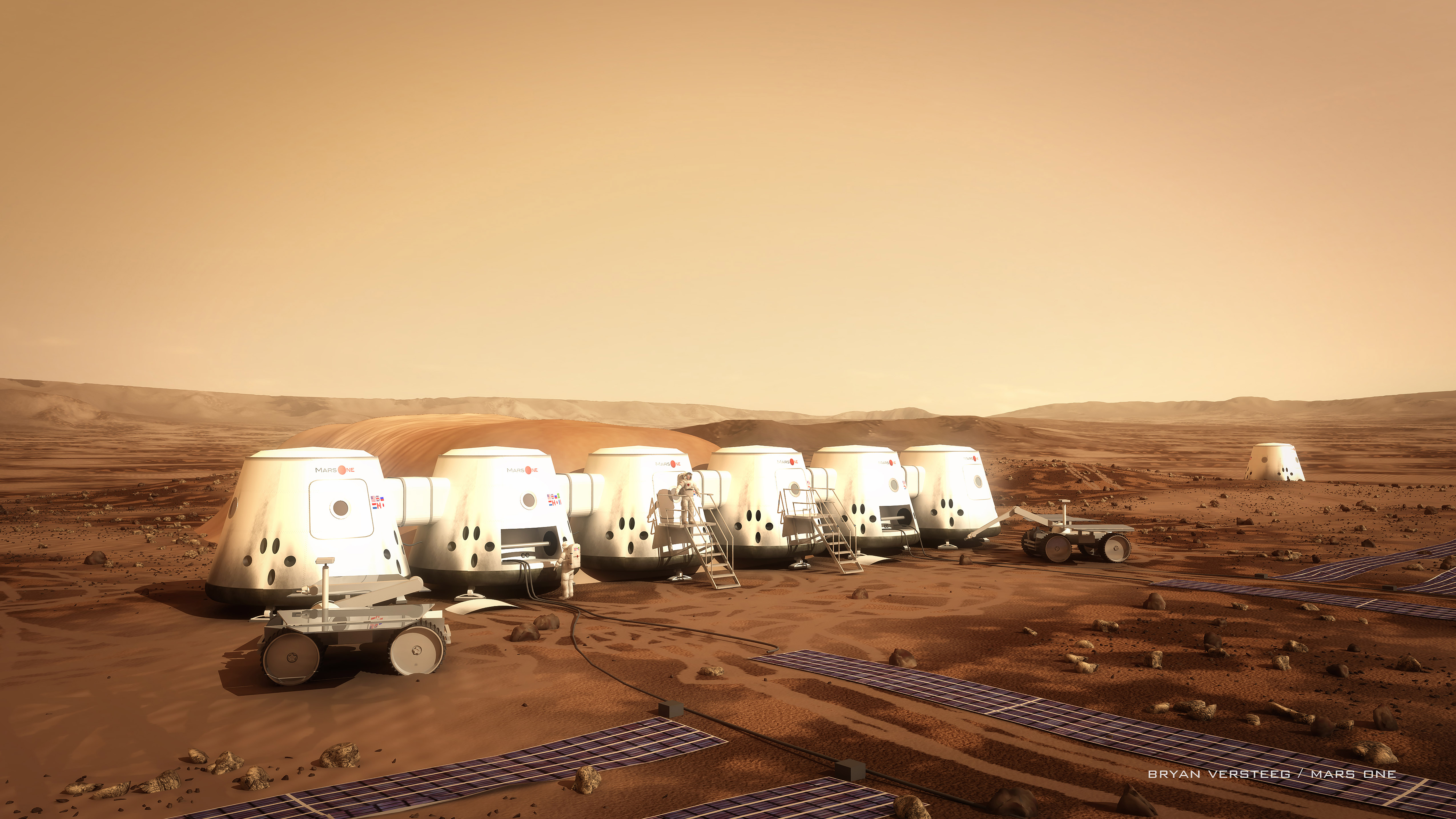
After people ask me about Neil deGrasse Tyson when they learn I like astrophysics, they usually bring up the Mars One project. 

In April of 2013, the team released an application for the truly once in a lifetime experience: living on Mars. The catch? You never come back.

That didn't scare off the 200,000 applicants to the colony. Over a few months 100 suitable people were selected. Over the next few years they will go though intense training that includes isolation, extreme weather conditions, and complex problem solving. 

I am currently trying to find a way to contact someone working directly with the project. I have questions about what season the team is choosing to launch the astronauts during, and the specific reasons why. According to the seasons the distance between planets change. Also, the positions of the camp could cause the astronauts to freeze to death. 


The progress of the Mars One mission will be closely followed by astrophysicists everywhere. It is very exciting to be entering the field during such a pivotal venture. 


Blog #16

Answer 2


1.  What is your EQ?
What is the most effective way to identify a primordial black hole?

2.  What is your first answer? (In complete thesis statement format)
The most effective way to identify a primordial black hole is to use gamma ray telescopes and creating histograms of radiation and comparing them to preexisting models from primordial black hole radiation. 

3.  What is your second answer? (In complete thesis statement format)
The most effective way to identify a primordial black holes is to use radio telescopes to identify sources.

4.  List three reasons your answer is true with a real-world application for each.
  1. When PBHs evaporate, they give off radiation which could be detected by gamma ray telescopes on earth.
  2. When PBHs evaporate, they would also give off some acoustic sound which could be detected by radio telescopes.
  3. You would never be able to see a PBH evaporate, therefore we must resort to listening and detecting their radiation. 
5.  What printed source best supports your answer?
PATTERSON, ELLINGSON, MARTIN, DESHPANDE, SIMONETTI, KAVIC, and CUTCHIN. "Searching for Transient Pulses with the ETA Radio Telescope." ACM Transactions on Reconfigurable Technology and Systems 20th ser. 1.4 (2009).

6.  What other source supports your answer?
Halzen, F., E. Zas, J. H. Macgibbon, and T. C. Weekes. "Gamma Rays and Energetic Particles from Primordial Black Holes." Nature 353.6347 (1991): 807-15.

7.  Tie this together with a  concluding thought.

Both methods have to do with ground detection.

Blog #15

Independent Component 2 Approval

1. Describe in detail what you plan to do for your 30 hours.
I am taking a C++ class at Cal Poly Pomona. 


2. Discuss how or what you will do to meet the expectation of showing 30 hours of evidence.
I can provide my transcripts and the actual homework assignments as evidence for my work.

3. Explain how this component will help you explore your topic in more depth.

Astrophysics is all about computing and analyzing nowadays. It has more to do with numbers than astronomy itself. In order to compute and analyze efficiently, astrophysicists need to know a few programming languages so that they can utilize the software.


Independent Component 1

I, Emaan Ahmed, affirm that I completed my independent component which represents 31 hours of work.

I have created the outline for the content, audio, and visual aspects of a video about primordial black holes. My intention was to create the video itself, however that would equate to more than 30 hours because of production. My topic has nothing to do with filming and animation so I did not pay much attention to producing it.

Completing a 2 1/2 minute video requires more information than I expected. The timing of visuals and narration (both of which are based off of real journals) is difficult. But it really helped my teaching skills. Eventually, I want to teach and mentor high schoolers so I have to practice explaining complex concepts like "escape velocity" in a simple way. I chose to include an animation of a rocket lifting off a moon compared to a rocket lifting off the earth and show a discrepancy in the amount of fire used to represent the speed of the rocket. Also, I needed to choose the right music because it really helps people get excited about topics that may come off as boring like the charges of black holes. I chose this (link) particular song because it's called "Sky Full of Stars" and people already associate it with the space. It's upbeat to get people excited but light enough to not interfere with the content. 

Compiling the content wasn't very difficult. I just spent more time looking over my research articles and new ones. Teaching and simplifying the topic was hard, but helped me further my understanding of some astrophysical concepts. I didn't realize what a poor understanding I had of black holes. I knew that some theorized that black holes lead potentially lead to wormholes, and that some black holes were charged. But I never knew that charged black holes were the ones that lead to wormholes. Creating this (link) took a few hours and drafts between a professor and I, and I am still not done! We have only chosen specific content to include so far. Let alone the official script.


Animations:

The discovery of black holes is usually attributed to Pierre-Simon Laplace. While Laplace was calculating the speed objects need to reach to “break free” from an astronomical object’s gravitational pull, aka escape velocity.


All physical bodies are attracted to each other. The gravitational force between bodies is directly proportional to their masses.The bigger the mass, the stronger the force of gravity is.


On Earth, gravity gives weight to physical objects employing a downward force to keep them grounded. In order to break free from the gravitational pull of earth, an object must exceed earth's escape velocity.


The escape velocity is the speed at which an object's force would be greater than earth's gravitational force. 


After an object reaches a certain density, it would be impossible for anything to escape it’s gravitational pull, including light. Hence the name “black hole”. A black hole looks exactly how you would imagine: black and round. They vary in size from the size of a penny to galaxy.


VERITAS is ground based gamma ray observatory. Each of four telescopes are have a 4 meter diameter. Telescopes like those at VERITAS have the capacity to detect a primordial black hole if one was ever to come across their path.


Here are a few visuals and visual inspirations for the video:


Sources:

Halzen, F., E. Zas, J. H. Macgibbon, and T. C. Weekes. "Gamma Rays and Energetic Particles from Primordial Black Holes." Nature 353.6347 (1991): 807-15. Web.

Bains, Jagdev. "Searching for Evaporating Primordial Black Holes Using Fermi Gamma Ray Telescope Data." Diss. Imperial College, 2011. Print.

Hawking, Stephen. The Illustrated a Brief History of Time. New York: Bantam, 1996. Print.

Khatri, Poudel, Gautam, M.K. , P.R. , A.K. (2010). Principles of Physics. Kathmandu: Ayam Publication.

Carroll, Sean M. (2004). Spacetime and Geometry. Addison Wesley.

http://www.deepastronomy.com/how-do-we-know-black-holes-exist.html

http://casa.colorado.edu/~ajsh/rn.html

http://jila.colorado.edu/~ajsh/insidebh/rn.html


Blog #13

Lesson 2 Reflection


1.What are you most proud of in your Lesson 2 Presentation and why?
2. a.     What assessment would you give yourself on your Lesson 2 Presentation (self-assessment)?

       AE       P          AP       CR       NC

     b.     Explain why you deserve that grade using evidence from the Lesson 2 component contract.

The audience was involved with the activity. I went around to every table to answer specific questions that they had. I gave the audience members a chance to present their pieces for themselves too because I don't believe you understand something thoroughly until you can explain it to someone else. 

I provided a lot of theoretical evidence on the existence of primordial black holes. I provided the very histograms I used to model and create my own. I spent time talking about where I got the data from to run through the models. 

My power point had an overall dark theme with geometric shapes and sharp lines that were supposed to represent mathematical models and space itself. I put a lot of effort into making sure the audience felt that overwhelming feeling that is essential to being an astrophysicist. Overwhelmed by how complicated the universe is through my hook video that I made. 

I dressed and carried myself out as any scientific researcher would while presenting research. My information and data was presented in a way that was similar to real presentations but simple enough for those not familiar with my topic to understand.

3. What worked for you in your Lesson 2?

I really enjoyed my activity. People got SO creative with their models and it made me happy that I explained it to an extent where the audience could be so quirky and specific with their models.

4. What didn't work? If you had a time machine, what would you have done differently to improve your Lesson 2?

If I had a time machine, I would change my engagement with the audience. I may have shown some disappointment with certain models. I should have emphasized the howthey still related to astrophysics, even if only minutely.  

I would have liked to talk about my mentorship more. I think what exactly I do was unclear. Showing the audience what I did with visuals and even live demonstrations would help them understand the concepts better. 

I also lost my green laser pointer. I really wanted to present with my green laser pointer. I waited so long for it because astronomers use really high powered green lasers and my laser pointer would have been a nod to that.

5. What do you think your answer #2 is going to be?

Something to do with radio astronomy because it has been postulated that PBH's also make an acoustic detectable noise. I am very excited to learn more about radio astronomy.

Blog #12

Mentorship 10 Hours Check

1.   Where are you doing your mentorship?

UCLA.

2.   Who is your contact?


Dr. Taylor Aune.

3.   How many total hours have you done (total hours should be reflected in your mentorship log located on the right hand side of your blog like your WB)?


151.5 hours.

4.   Summarize the 10 hours of service you did.


I focused on a code that counted the amount of gamma ray events in a certain period of time.